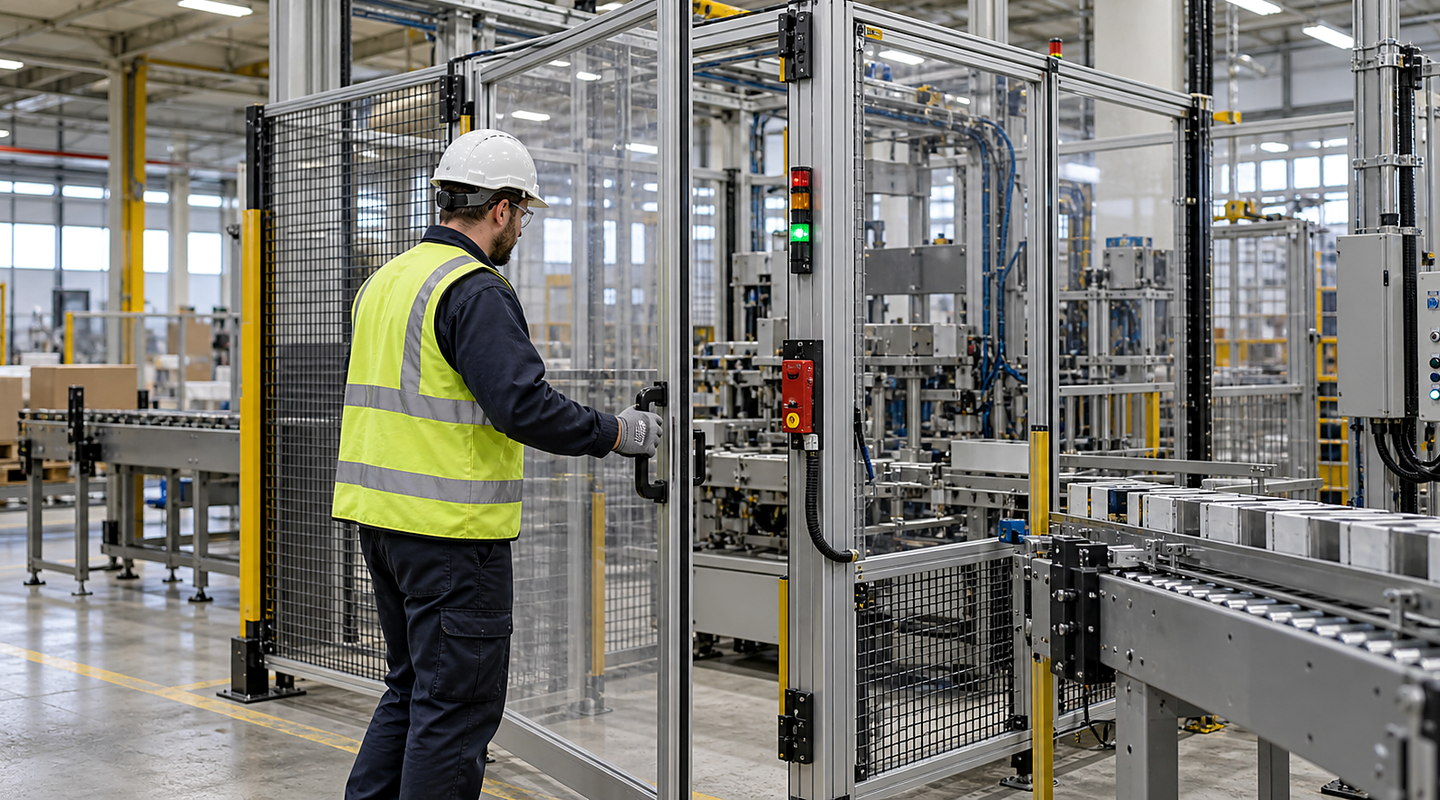
Guard Locking Systems Selection Guide
Compare guard-locking concepts using hazard persistence, access tasks, guard-position and locking states, controlled release, faults, power loss, escape and validation evidence.
Compare concepts against the same hazard-persistence and access assessment. Ask how guard position, locking, release and restart states will be established and monitored. Include the normal entry sequence, faults, power loss and any whole-body access or escape requirements before judging a locking component or control concept.
Connect the access-sequence process with the same installed-function evidence. Frequent intervention does not by itself determine whether interlocking alone, guard locking or another assessed safeguarding arrangement is suitable.
Compare options in the conditions where they must work — Guard Locking Systems
Plan guard locking systems around your machine hazards, operator tasks, access, stopping behaviour and validation evidence. Discuss a site-specific safeguarding concept with Oxford Machine Guarding. A useful shortlist should show how every option copes with hazards and foreseeable access for guard locking & controlled release and space, visibility and operator ergonomics.
Discuss your application
Ask every supplier the same questions
| Decision | What to ask | What to check |
|---|---|---|
| Hazards and Foreseeable Access for Guard Locking & Controlled Release | What remains hazardous after a stop, which access routes exist, and can someone enter the safeguarded space? | Machine layout, task-based assessment, hazard persistence and every relevant access door. |
| Machine Motion and Stopping Behaviour | How is the release condition established for the actual machine and stopping/continuing hazards? | Recorded stopping/hazard information and the assessed evidence for release; no copied delay assumption. |
| Operating, Cleaning and Maintenance Tasks | What is the normal access-request, waiting, entry and return-to-production sequence for each task? | A defined sequence for operation, setting, cleaning and maintenance, with responsible owners. |
| Existing Control-System Architecture | How are closed, locked, release-permitted, fault and restart states distinguished, monitored and connected to the machine? | State/interface drawings, control responsibilities, fault/power-loss behaviour and validation scope. |
| Space, Visibility and Operator Ergonomics | How will users distinguish waiting, permitted entry and faults, and what occupancy/escape/access arrangements need assessment? | Reviewed access routes, indications and whole-body entry/escape/restart requirements where relevant. |
| Risk-Reduction and Validation Evidence | What installed mechanical, sensor, logic and machine-response checks will establish the agreed function and fault behaviour? | Expected/observed results, settings, drawings, unresolved actions and inspection/maintenance responsibilities. |
Include simpler approaches to guard locking and controlled release in your shortlist
| Approach | Often suitable when | Watch for |
|---|---|---|
| Guard Locking Systems | The machine assessment identifies a need to control release of an access guard while relevant hazards persist. | Validate mechanics, monitoring, release and machine response together, including faults and occupied-space arrangements where relevant. |
| Fixed Physical Guarding where Access Is Rare | The assessment finds fixed physical guarding practical for the actual tasks and access frequency. | Review fixing and maintenance/isolation access; a fixed barrier is not a substitute for assessing all entry routes. |
| Interlocked or Presence-Sensing Protection where Frequent Intervention Is Foreseeable | The assessment supports considering another access-protection concept for the actual task and hazard behaviour. | Do not assume frequent entry makes interlocking alone sufficient; compare hazard persistence, access time, fault response and required validation. |
Pause before choosing when…
- Only perfect or hand-selected examples of safeguarding existing machinery for guard locking and controlled release are available.
- No one has defined how risk-reduction and validation evidence will be evaluated.
- The normal range for hazards and foreseeable access for guard locking & controlled release is described only as “usually fine” but has not been bounded.
- Your operator, cleaning, maintenance or recovery access has not been considered.
- Quoted performance depends on another machine or data source that is not included.