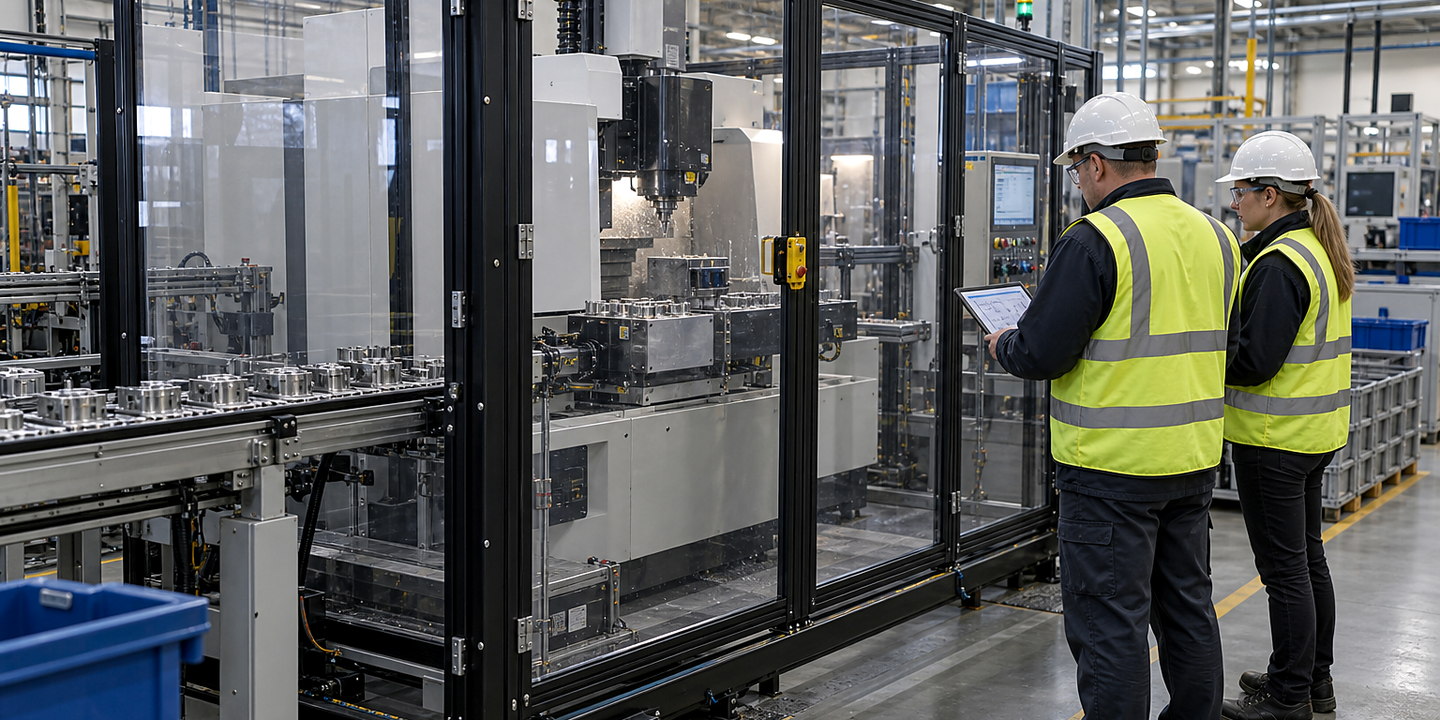
About Guard Locking Systems
Oxford Machine Guarding handles guard-locking and controlled-release enquiries, starting with machine hazards, access tasks, stopping information, control drawings and validation requirements.
Oxford Machine Guarding handles enquiries about guard locking and controlled release. Share the machine layout, access tasks, stopping information and existing control drawings, including any space a person can enter. The enquiry should establish the assessment scope and the locking, monitoring, release and restart functions that need review.
Review the controlled-access process and concept comparison questions. The locking device alone does not resolve hazards, occupied-space arrangements or validation of the complete machine function.
Specialist engineering for a clearly defined production need — Guard Locking Systems
Plan guard locking systems around your machine hazards, operator tasks, access, stopping behaviour and validation evidence. Discuss a site-specific safeguarding concept with Oxford Machine Guarding. Oxford Machine Guarding handles enquiries about guard locking and controlled release directly.
Discuss your application

Oxford Machine Guarding
Oxford Machine Guarding focuses on machinery safety assessment, guarding design and remedial engineering. For guard-locking enquiries, provide the machine layout, access tasks, hazard and stopping information and current control drawings.
Agree how guard position, locking condition, access requests, release and restart are defined for the installation. Include faults, power loss and any whole-body access or escape arrangements in the assessment, with responsibilities and required validation evidence made explicit.
Legal operator: Oxford Machine Guarding Ltd, company number 17436461. Registered office: Unit 133, 5 High Street, Maidenhead SL6 1JN, United Kingdom.
Clear advice about guard locking systems, grounded in your application
- Questions about hazards and foreseeable access for guard locking & controlled release and your real operating range
- Clear options and important limitations
- Focused trials where machine motion and stopping behaviour creates uncertainty
- Direct contact with Oxford Machine Guarding
- Practical next steps for safeguarding existing machinery for guard locking and controlled release