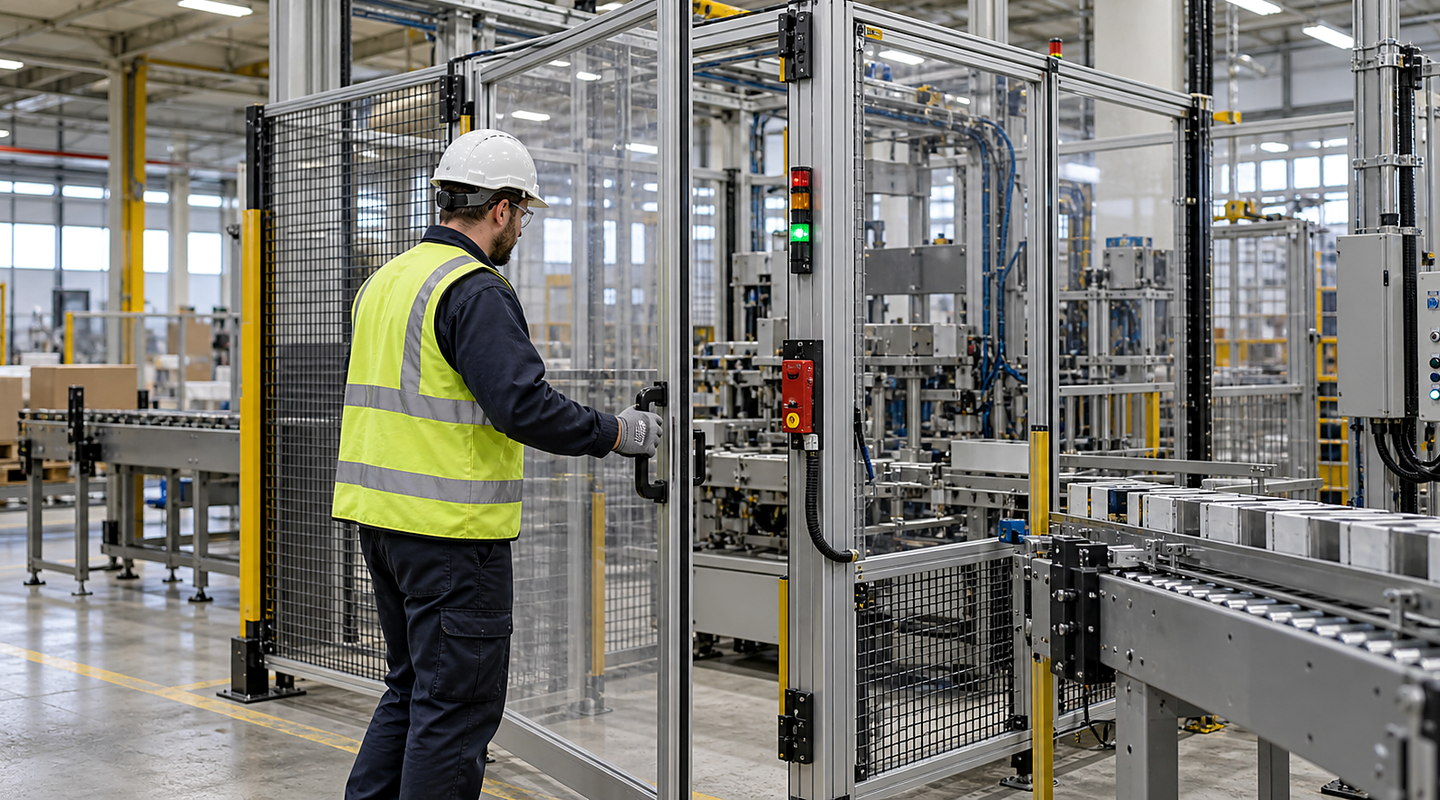
Guard Locking Systems: How the Process Works
Plan guard locking from hazards and stopping behaviour through guard-position and locking states, access requests, controlled release, fault handling and installed-function validation.
Map the machine hazard, how long it persists and the access routes before choosing guard locking. Define guard position and locking condition separately, then agree the access request, release permission, fault response and restart sequence. Include whole-body access and escape where relevant and validate the complete installed function.
Use the controlled-access comparison questions and validation evidence checklist. A door that appears closed or an assumed release delay does not establish the specified safety function.
Understand the complete route from input to accepted output — Guard Locking Systems
Plan guard locking systems around your machine hazards, operator tasks, access, stopping behaviour and validation evidence. Discuss a site-specific safeguarding concept with Oxford Machine Guarding. Follow the material or part through each operating step and include recovery, cleaning and change in the real cycle.
Discuss your application

Four clear stages for guard locking systems
At each stage, you can review how hazards and foreseeable access for guard locking & controlled release and risk-reduction and validation evidence affect the next commitment.
- 01
Map Access Tasks and Continuing Hazards
Record the machine layout, access doors and normal and foreseeable entry tasks. Include relevant run-down, stored or continuing hazards and any space a person may enter.
- 02
Define Locking, Release and Restart States
Distinguish guard position from the locking condition and document how the release condition is established. Agree the normal access-request, waiting, entry and restart sequence with responsible personnel.
- 03
Coordinate Guard Mechanics, Monitoring and Controls
Review mounting, sensors, logic and the machine response as one function. Agree fault and power-loss behaviour and the purpose and controlled return-to-service arrangements for any emergency or auxiliary release.
- 04
Validate the Installed Access and Recovery Sequence
Agree and carry out relevant inspection and validation of normal and abnormal states for the installed arrangement. Retain expected/observed results, drawings, settings, unresolved actions and inspection and maintenance responsibilities.
Decisions and results stay connected
| Stage | What happens | What you can review |
|---|---|---|
| Map Access Tasks and Continuing Hazards | Record the machine layout, access doors and normal and foreseeable entry tasks. Include relevant run-down, stored or continuing hazards and any space a person may enter. | Machine layout, access routes/tasks, hazard persistence and assessment boundaries. |
| Define Locking, Release and Restart States | Distinguish guard position from the locking condition and document how the release condition is established. Agree the normal access-request, waiting, entry and restart sequence with responsible personnel. | State/sequence definition, release evidence, indications and implementation responsibilities. |
| Coordinate Guard Mechanics, Monitoring and Controls | Review mounting, sensors, logic and the machine response as one function. Agree fault and power-loss behaviour and the purpose and controlled return-to-service arrangements for any emergency or auxiliary release. | Mechanical/control interfaces, monitoring, faults, power-loss and release/recovery responsibilities. |
| Validate the Installed Access and Recovery Sequence | Agree and carry out relevant inspection and validation of normal and abnormal states for the installed arrangement. Retain expected/observed results, drawings, settings, unresolved actions and inspection and maintenance responsibilities. | Expected and actual results, settings/drawings, unresolved issues and responsible handover. |
Keep connected responsibilities clear
Your final guard locking systems scope must also account for space, visibility and operator ergonomics, risk-reduction and validation evidence, current regulations and the conditions at your site.
- Current standards and required performance levels must be assessed for the complete machine and intended use.
- A site survey and task-based risk assessment are required before a safeguard is selected.
- Mechanical changes can affect access, visibility, cleaning and machine operation.